That amazing iPhone deal on Facebook Marketplace might be too good to be true. Hundreds of buyers discover this the hard way every day.
This happens because of something called blacklisting.
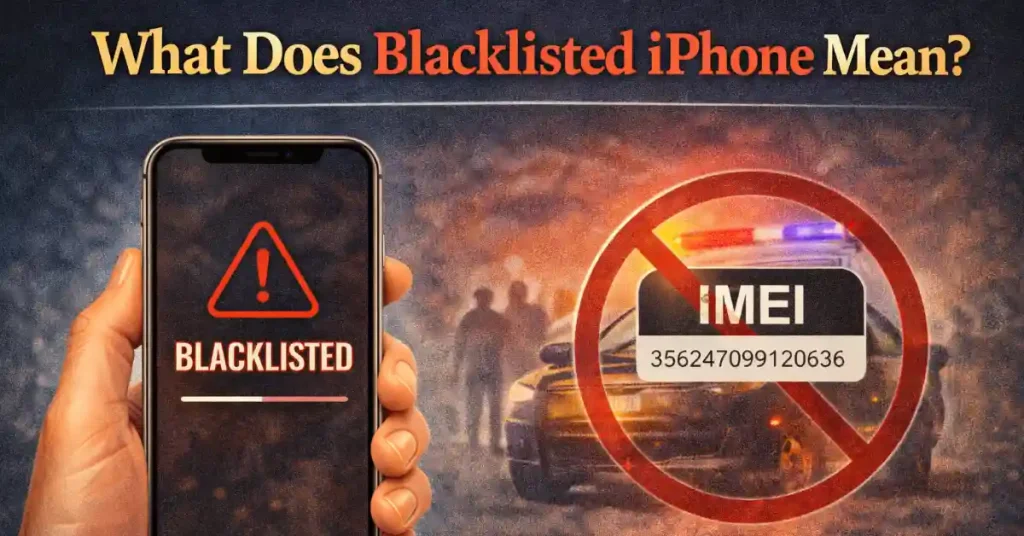
What does it mean when an iPhone is blacklisted? The phone’s unique ID number gets flagged in a global database. Carriers block it from using cellular service anywhere in the world.
The phone gets blacklisted when someone reports it lost or stolen.
It also happens when people don’t pay their phone bills. The device still works on Wi-Fi, but you can’t use it like a normal phone.
This guide will show you everything you need to know about blacklisted iPhones so you don’t waste your money.
What It Means to Have a Blacklisted iPhone
A locked iPhone is disconnected from its cellular network.
Its IMEI number is added to a database managed by the GSMA, which is used by over 750 phone companies worldwide.
If your phone is blacklisted, you can’t make or receive calls, send regular texts, or use cellular data. However, Wi-Fi still works, so you can use iMessage, FaceTime, and browse the internet.
These notifications usually mean the owner reported the phone as lost or stolen to protect their personal information.
Carriers also blacklist phones when bills go unpaid. Once blacklisted, the phone is almost useless for normal use.
Here’s How Your iPhone Can Get Blacklisted
There are three primary reasons iPhones become blacklisted. Each one has carrier protection measures.
- Reported Lost or Stolen: This is the most common reason.
When people lose their iPhone or it gets stolen, they are quick to call their carrier. The IMEI number is added to the GSMA database within one hour of carrier inclusion.
This prevents thieves from using the phone or selling it. And it shields the owner’s personal data. - Unpaid Phone Bills: Many people buy iPhones on payment plans with carriers like AT&T, Verizon, or T-Mobile.
If you don’t pay your monthly bills, the carrier will blacklist your phone until you pay off what you owe.
This is especially common with financed iPhones. - Insurance Fraud: Some individuals make fraudulent insurance claims, claiming their phone was stolen.
They get a new phone through insurance, then sell the original for cash. Carriers track these cases using serial numbers and will blacklist phones involved in fraud.
The Key Difference: Blacklisted vs Carrier Locked
Many people mistakenly think blacklisted phones and carrier-locked phones are the same, but they are actually very different.
A carrier-locked phone will only work with a particular carrier.
Calls, texts, and data all still work. You’ll just have to use the original carrier’s SIM card. For the most part, locked phones can be unlocked with a code.
A blacklisted phone won’t work on any network, no matter which SIM card you use. It won’t connect to any carrier anywhere.
You can’t unlock a blacklisted phone in the usual way. Unlocking only removes carrier restrictions, but blacklisting blocks all cellular service.
Here’s a quick comparison:
| Feature | Carrier Locked | Blacklisted |
| Can make calls? | Yes (original network only) | No (any network, globally) |
| Can use data? | Yes (original carrier) | No cellular; Wi-Fi only |
| Can be fixed? | Yes (unlock code) | Rarely (owner/carrier only) |
| Legal status? | Legitimate, resalable | Potential stolen goods |
| Value impact? | 80-100% retail | 10-30% for parts |
The distinction is significant when it comes to purchasing used phones. As far as inconveniences go, a locked phone is pretty benign.
You can consider a blacklisted phone pretty much worthless. iPhones can also face other restrictions, like iCloud locks.
Check out what to do with an iCloud-locked iPhone if you encounter that issue.
How to Tell if an iPhone is Blacklisted Before Buying
It is always wise to check a second-hand iPhone’s status before you part with your money. Always check a used iPhone’s status before you buy it. Here’s how you can do that.
Type *#06# on the phone to display it immediately. Alternatively, you can navigate to the Settings > General > About. The SIM card tray also bears the IMEI.
Look in the original box, if you still have it.
Use Free IMEI Check Tools: Many websites offer free IMEI checks, such as IMEI.info, CTIA.org, or IMEI24.com. These tools connect to the GSMA database and tell you if the phone is blacklisted in seconds.
Other options include SNDeepInfo, iUnlocker, and iMEIsCheck.
Try the Carrier Directly: Call the original phone company with the IMEI number to check its status. Verizon, AT&T, and T-Mobile can look it up in their databases.
You can also use paid services like CheckMEND for detailed reports.
Another tip: Try inserting a SIM card from a different carrier. If you see “No Service” on the screen, there may be a problem. You can double-check using GSMA tools.
Is It Possible to remove the Blacklist From iPhone?
Removing a blacklist is difficult, and the answer depends on your situation.
If You Own the Phone: Contact your carrier as soon as possible. Pay any outstanding charges on your plan.
Provide proof of ownership if needed, and share a police report if you recovered a lost phone. In these cases, carriers like Verizon have removed blacklists.
If You Bought a Blacklisted Phone: Carriers rarely help people who aren’t the original owners. Your best option is to ask the seller for a refund. Most reputable sellers will accept returns of blacklisted devices.
Be cautious of “IMEI cleaning” services. Companies like Dr.Fone or SafeUnlocks claim to remove blacklists, but most of these services are scams.
They could make things worse by adding more blocks or voiding your warranty.
What You Actually Can Do With a Blacklisted iPhone
Blacklisted iPhones aren’t totally useless. You still have a few options.
Use It With Wi-Fi Only: The phone works like an iPod Touch.
You can run apps, stream music and videos, and browse the web. iMessage and FaceTime will work with your Apple ID, but you can’t make regular calls or send texts.
Sell the Parts: The screen, camera, and battery still have value.
You can sell these parts to repair shops and usually get about 10-30% of the phone’s original value. For example, parts from an iPhone 14 might bring in $100-200.
Sell It to Parts Buyers: Always disclose that it’s blacklisted.
Hiding this information is illegal. Specialty resellers buy blacklisted phones, only to use them for parts.
Major mobile carriers and Apple won’t accept blacklisted phones for trade-ins. Being honest from the start protects you legally.
Will a Blacklisted iPhone Work in Other Countries?
You won’t get cell phone service in most countries. Wi-Fi and iMessage still work well, but roaming blocks are everywhere.
Swapping SIM cards won’t help; this myth has been debunked many times.
The phone might work in a few countries that aren’t GSMA partners, but these cases are rare. It’s usually not worth the risk.
Selling or Trading Your Blacklisted iPhone
Blacklisted iPhones are cellular dead zones. They work on Wi-Fi but can’t connect to any mobile network worldwide.
The GSMA database ensures blocks work across hundreds of carriers. Unless you’re the original owner with solid proof, removal is nearly impossible.
Your selling options are limited. Specialty buyers offer 10-30% of retail value for parts.
Apple and major carriers reject trade-ins completely. Always be honest about the phone’s status. Selling a blacklisted phone as “functioning” is fraud.
Buying a blacklisted iPhone is equally risky. You could face fraud charges if it’s stolen. The device has almost no resale value. Suspiciously low prices should raise immediate red flags.
Before buying any used iPhone, check the IMEI number. Free tools can save you hundreds of dollars in seconds. Online forums overflow with horror stories from buyers who skipped this step.
If you already own a blacklisted phone, use it on Wi-Fi or sell it for parts, honestly.
Your best protection is knowledge. Now you have it, and that “too good to be true” deal will never fool you again.
Commonly Asked Questions
1. Is a blacklisted phone useless?
Ans- Not completely. It still works on Wi-Fi for apps, streaming, iMessage, and FaceTime, and can be sold for parts at 10-30% of retail value, but it can’t make calls, send texts, or use cellular data on any network.
2. Can a blacklisted iPhone be used in another country?
Ans- No, the GSMA database blocks cellular service internationally across over 750 carriers worldwide, though Wi-Fi and iMessage still work everywhere.
3. Can a blacklisted phone connect to Wi-Fi?
Ans- Yes, blacklisting only blocks cellular service. Wi-Fi connectivity, apps, streaming, iMessage, and FaceTime all work normally.
4. Will Apple replace a blacklisted iPhone?
Ans- No, Apple automatically rejects blacklisted devices from all trade-in, replacement, and repair programs after checking IMEI numbers.